
Get back to blogging after a missed week
Missing a week of blogging can feel heavier than it should.
You didn’t plan to stop. Life got busy, energy dipped, or priorities shifted. And suddenly a small pause starts to feel like a setback. Many bloggers don’t stop because they lack ideas—they stop because they don’t know how to restart without guilt or pressure.
This guide exists to change that.
If you’ve missed a week (or more), you don’t need to “catch up,” apologize to your blog, or overhaul your system. You need a calm reset—one that respects your time and helps you move forward without overwhelm.
First: Missing a Week Is Normal (And Not a Failure)
Before talking about what to do next, it’s important to reframe what a missed week means.
A missed week does not mean:
- You’re inconsistent
- You’ve failed
- Your blog is off track
- You’ve lost momentum permanently
It means something else took priority—for a moment.
Understanding how blogging actually works helps here. Progress compounds over time through steady habits, not perfect streaks. One pause does not undo your work.
If you need a refresher on the long-term nature of blogging, How Blogging Actually Works (A Simple Explanation for Busy Beginners) explains why breaks are part of the process.
Why Restarting Feels Harder Than Starting
Many people find it easier to start a blog than to resume one after a pause. That’s because restarting carries emotional weight.
Common thoughts include:
- “I should have done more.”
- “I’m behind now.”
- “What’s the point if I can’t be consistent?”
These thoughts make the task feel bigger than it is. The goal isn’t to erase the pause—it’s to re-enter gently.
The Calm Reset: A Simple Way Back In
Instead of asking, “How do I catch up?” ask:
“What’s the smallest next step?”
Here’s a reset approach designed for busy beginners.
Step 1: Acknowledge the Pause (Briefly, Then Move On)
You don’t need to analyze the missed week in detail.
A simple acknowledgment is enough:
- “I missed a week.”
- “That’s okay.”
- “I’m continuing.”
Avoid journaling about guilt or creating new rules. The pause doesn’t need a story—it needs a boundary.
Step 2: Lower the Bar for the First Session Back

Your first session back should be intentionally small.
Good first-day goals include:
- Opening the draft you were working on
- Writing a rough outline
- Editing one section
- Adding notes for later
This pairs well with How to Make Progress on a Blog Post in 30 Minutes, where short, focused sessions reduce resistance.
Step 3: Continue the Last Thing You Touched
Do not start something new unless the old draft feels impossible.
Returning to the last open file:
- Reduces decision fatigue
- Preserves momentum
- Makes progress visible quickly
If you forgot where you left off, skim the last paragraph and write one sentence that moves it forward. That’s enough.
Step 4: Adjust Expectations for the Week Ahead
After a missed week, many bloggers try to “make up for it.” This often leads to burnout.
Instead:
- Resume your previous pace
- Or choose a lighter one for this week
Consistency is built by repeating doable actions—not by doubling effort.
If writing time feels tight, How to Write Blog Posts When You’re Short on Time offers ways to stay consistent without long sessions.
Step 5: Reframe Consistency (What It Actually Means)
Consistency does not mean:
- Posting on fixed days forever
- Never missing a week
- Keeping perfect routines
Consistency means:
- Returning when you pause
- Continuing without self-punishment
- Building a habit you can resume
A missed week followed by a calm restart is still consistent.
What to Do If You Missed More Than One Week
The same principles apply—just slower.
If the break was longer:
- Start with reading, not writing
- Review your last post or outline
- Choose one small task
- Avoid announcing a “comeback”
Your blog doesn’t need explanations. It needs presence.
Common Restart Traps to Avoid
Trying to catch up all at once
This increases pressure and reduces clarity.
Changing your entire system
Overhauls delay progress.
Waiting for motivation
Action creates momentum—not the other way around.
Rewriting your goals immediately
Resume first. Reflect later.
A Gentle 7-Day Reset (Optional)
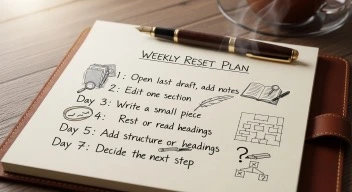
This is optional—use it only if it helps.
- Day 1: Open last draft, add notes
- Day 2: Edit one section
- Day 3: Write a small piece
- Day 4: Rest or read
- Day 5: Add structure or headings
- Day 6: Light edit
- Day 7: Decide the next step
You can stretch this across two weeks if needed.
Why Breaks Don’t Hurt Your Blog the Way You Think
Many beginners worry a missed week will:
- Harm visibility
- Confuse search engines
- Ruin growth
In reality, short breaks rarely have lasting impact. Blogs grow through cumulative content and long-term trust.
If monetization is a concern, When a Blog Actually Starts Making Money (Realistic Timeline) explains why consistency over months matters more than weekly perfection.
Who This Approach Is For (And Who It’s Not)
This is for you if:
- You blog alongside real life
- You want sustainable habits
- You value calm progress
- You struggle with guilt after pauses
This may not fit if:
- You thrive on strict schedules
- You prefer intense productivity sprints
- You enjoy rigid routines
Both approaches can work. This one prioritizes longevity.
Frequently Asked Questions
Does missing a week hurt my blog?
Usually no. Short breaks are common and rarely harmful.
Should I explain the break to readers?
Not necessary. Continue as usual.
What if I feel disconnected from my topic?
Re-read your last post and start small.
How long should my first session back be?
As short as it needs to be. Even 15–30 minutes counts.
What if I miss weeks often?
That’s a signal to simplify—not quit.
The Bottom Line
Missing a week of blogging is not the problem.
Staying stuck because of it is.
You don’t need to make up for lost time.
You don’t need to prove commitment.
You don’t need to restart from zero.
You just need to continue—calmly, gently, and realistically.
That’s how blogging becomes sustainable.
.