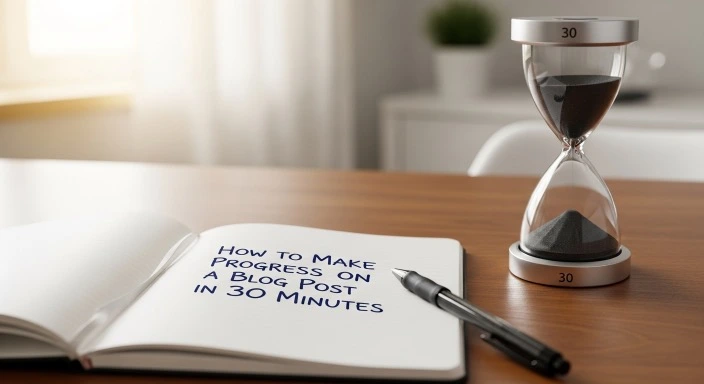
Make progress on a blog post in 30 minutes
When you’re busy, blogging often feels like something that requires a long, quiet stretch of time.
An empty house.
A clear mind.
Hours you don’t really have.
So when you only have 30 minutes, it’s easy to think: What’s the point?
That thought alone is enough to stop many people from opening their draft at all.
This article exists to gently challenge that idea.
You don’t need long writing sessions to make progress. You need clear focus, realistic expectations, and permission to work in small pieces. This guide will show you how to make meaningful progress on a blog post in 30 minutes — even if you’re tired, distracted, or still figuring things out.
Progress doesn’t have to be dramatic to be real.
What “Progress” Actually Means in 30 Minutes
Before we talk about how to use 30 minutes, it’s important to redefine what progress looks like.
Progress does not mean:
- Writing a full blog post
- Perfecting your wording
- Publishing immediately
- Feeling inspired the entire time
Progress does mean:
- Moving a post forward
- Reducing uncertainty
- Making the next session easier
- Turning vague ideas into clearer ones
Understanding how blogging actually works helps here. Blogs grow through consistent, small actions that compound over time — not through occasional bursts of intensity.
Thirty minutes is more than enough to take one meaningful step.
Why Short Writing Sessions Work Better Than You Think
Short sessions often work better than long ones, especially for beginners.
Here’s why:
- Less pressure to “do everything”
- Fewer distractions
- Easier to start
- Easier to repeat
Long sessions tend to carry unrealistic expectations. Short sessions encourage focus.
If you already struggle with time, this approach aligns well with How to Write Blog Posts When You’re Short on Time, where consistency matters more than duration.
The Most Important Rule: Decide the Goal Before You Start
The biggest mistake people make in short writing sessions is starting without a clear goal.
If you open a draft and think, “I’ll just write,” your time gets scattered.
Instead, decide one specific task before the timer starts.
Good 30-minute goals include:
- Outlining one section
- Writing a rough introduction
- Expanding bullet points into paragraphs
- Editing one messy section
- Adding internal links
- Writing the conclusion
One task.
One direction.
A Calm 30-Minute Blogging Framework
Here’s a simple structure you can use again and again.
Minute 0–5: Settle and Decide
- Open the correct draft
- Re-read the last paragraph you wrote
- Decide exactly what you’ll work on
Do not check email.
Do not reread the whole post.
This is about orientation, not perfection.
Minute 5–25: Focus on One Piece
This is your main work window.
Depending on the stage of your post, this might look like:
- Writing freely without editing
- Turning notes into sentences
- Clarifying one idea
- Cutting unnecessary parts
- Rewriting for clarity
If your mind wanders, gently bring it back. You’re not behind — you’re practicing focus.
Minute 25–30: Create a Gentle Stopping Point

Before you stop:
- Add a short note about what to do next
- Highlight the next section to work on
- Write one sentence as a starting cue
This makes the next 30-minute session easier to begin.
What to Work On (Depending on Your Energy)
Not every 30-minute session needs to involve writing new words.
When energy is high
- Draft new sections
- Expand ideas
- Write freely without editing
When energy is low
- Edit for clarity
- Shorten sentences
- Add headings
- Organize structure
- Add links
Both types of work move the post forward.
Breaking a Blog Post Into 30-Minute Tasks
Most blog posts feel overwhelming because they’re treated as one large task.
Instead, think in pieces.
A typical post can be broken into:
- Topic clarification
- Outline
- Introduction
- Main sections
- Examples
- Conclusion
- Light editing
Each piece can be handled in a separate short session.
This approach pairs naturally with What You Need to Start a Blog — Keep It Simple: you don’t need complex systems, just manageable steps.
Why You Should Stop Mid-Thought (On Purpose)
It may sound strange, but stopping before you feel “done” can help.
When you stop mid-thought:
- You know exactly where to restart
- You reduce resistance next time
- You avoid draining all your energy at once
Leaving a small thread unfinished keeps momentum alive.
Common Mental Blocks in Short Sessions (And How to Handle Them)
“Thirty minutes isn’t enough”
It is — if you focus on one task.
“I won’t remember what I was doing”
Leave a note. Your future self will thank you.
“My writing feels rough”
Rough drafts are allowed. Clarity comes later.
“I should wait until I have more time”
That often means waiting indefinitely.
What to Avoid During 30-Minute Writing Sessions
This matters just as much as what you do.
Avoid opening new tabs
Research expands to fill all available time.
Avoid rewriting old sections endlessly
Progress means moving forward, not circling.
Avoid judging the quality
Quality improves through revision, not pressure.
Avoid multitasking
Thirty focused minutes beat an hour of distraction.
How These Short Sessions Add Up Over Time
One 30-minute session might not feel impressive.
But:
- Three sessions = 90 minutes of focused work
- Six sessions = a full draft
- Ten sessions = a polished post
Consistency compounds quietly.
This long-term view connects well with When a Blog Actually Starts Making Money (Realistic Timeline) — progress often shows up later than expected, but it does show up.
Who This Approach Works Best For
This is for you if:
- You blog alongside real life
- You prefer calm structure
- You want steady progress
- You struggle with long sessions
This may not fit if:
- You enjoy long, immersive writing blocks
- You prefer spontaneous writing
- You thrive on tight deadlines
Both approaches are valid. This one simply prioritizes sustainability.
Frequently Asked Questions
Can I really make progress in 30 minutes?
Yes, if you define progress clearly and focus on one task.
Should I write or edit in short sessions?
Both work. Choose based on energy.
How often should I do this?
As often as your schedule allows. Even a few sessions per week help.
What if I get interrupted?
That’s normal. Stop, leave a note, and return when you can.
Is it okay if some sessions feel unproductive?
Yes. Showing up still builds the habit.
The Bottom Line
You don’t need perfect conditions to blog.
You don’t need long writing sessions.
You don’t need endless energy.
You need clear focus and permission to work in small steps.
Thirty minutes is enough to make progress — not all the progress, but the next one. And over time, those small steps add up to real, sustainable growth.
Our Authority Sources
- Google Search Central – Guidance on how consistent content is discovered and evaluated
- Moz Blog – Research-based insights into content creation and focus
- Ahrefs Blog – Practical explanations of how small, consistent efforts compound
- Nielsen Norman Group – Research on attention, cognitive load, and clarity
.